VeriMarx – Frequently Asked Questions
Why should I use VeriMarx?
VeriMarx is best used as a first step—to identify potential risks, gain clarity, and make more informed decisions before purchasing, selling, or seeking further review.
VeriMarx is about insight, transparency, and informed decisions—not guarantees.
What does VeriMarx do?
VeriMarx uses AI technology to analyze autograph signatures by examining writing behavior, identifying potential forgery indicators, and performing comparative analysis against validated reference signatures. Each submission generates a report designed to help users better understand potential authenticity risk.
Does VeriMarx authenticate, certify, or verify autographs?
No. VeriMarx does not authenticate, certify, verify, or guarantee the authenticity of any autograph or item. The service provides analytical insights only and is intended to support informed decision-making, not replace expert review or third-party evaluation.
What does my VeriMarx score mean?
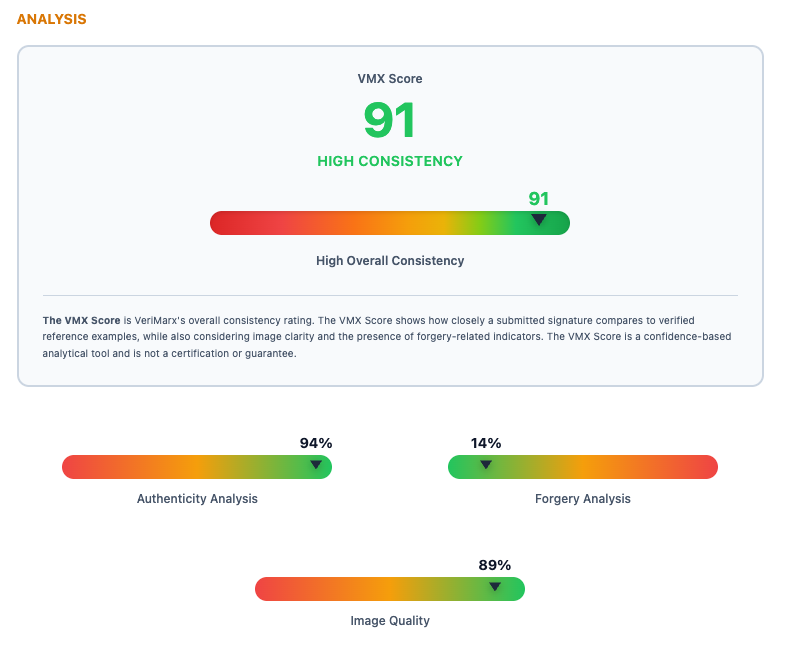
Your report reflects analytical findings based on handwriting behavior, forgery indicators, and comparative patterns. A higher score suggests closer alignment with expected writing characteristics, while a lower score may indicate greater deviation or higher authenticity risk.
Scores are not guarantees and should be interpreted as part of a broader evaluation process.
Can VeriMarx tell me if an autograph is real or fake?
No. VeriMarx does not make definitive determinations. Instead, it highlights patterns, consistencies, and potential red flags that may help you decide whether further review is warranted.
Why might a signature score be lower even if it looks good?
Some signatures appear visually appealing but still show indicators such as hesitation, unnatural stroke behavior, or structural inconsistencies that raise analytical concerns. VeriMarx examines how a signature was written; not just how it looks.
Why are some historical signatures harder to analyze?
Signatures from certain eras are inherently more challenging to analyze due to limited reference material, changes in writing instruments, and historical signing practices.
High-profile figures such as Babe Ruth, Lou Gehrig, and other pre-war athletes present unique challenges because:
Their signatures are heavily forged and widely imitated
Many authentic examples show natural variation over time
Reference material may be limited or inconsistent across periods
Items were often signed quickly, in bulk, or under informal conditions
As a result, even genuine signatures from these individuals may show greater variation and higher analytical uncertainty.
Does a lower score mean an autograph is not authentic?
No. A lower score does not mean an autograph is fake. It simply indicates that the signature shows greater deviation from reference patterns or includes characteristics commonly associated with higher authenticity risk.
Can a signature with a high score still be rejected by an authenticator?
Yes. VeriMarx analysis is independent and informational. Third-party evaluations may reach different conclusions based on in-hand examination, provenance, or criteria outside the scope of AI analysis.
Does image quality affect the analysis?
Yes. Image clarity, resolution, lighting, and angle can all impact the depth and accuracy of analysis. Poor-quality images may limit the ability to evaluate fine details such as ink flow or stroke edges, which will be reflected in the report.
Are results the same every time?
Analysis results may vary based on image quality, reference data, and ongoing system improvements. VeriMarx continually refines its technology, which means reports generated at different times may not be identical.
Why do some signatures require human expertise?
Certain autographs—especially rare, early, or historically significant items—may require physical inspection, provenance review, or expert judgment beyond what digital analysis alone can provide. VeriMarx is designed to complement, not replace, human expertise.
Is my data safe?
VeriMarx uses reasonable technical safeguards to protect user data. Images and reports are stored to support account access and submission history. We do not sell personal information, and users may opt out of marketing communications at any time.
Submission Instructions
1.Click the “Submit” button or the Submit link

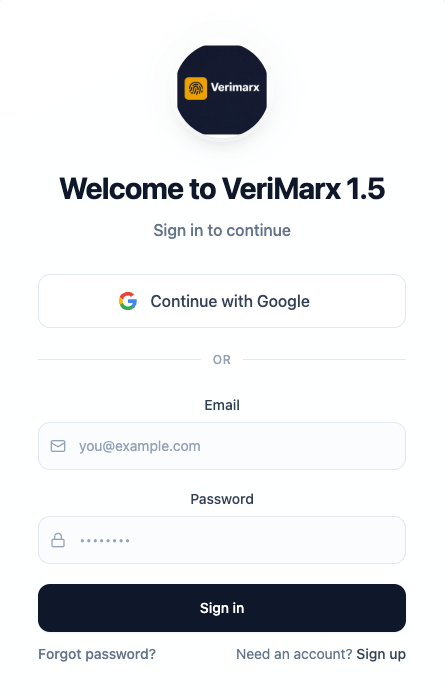
2. Create an account. You can sign up using your existing Google login or register with any other personal email address. After your account is set up, you will be able to use these credentials to log in anytime in the future.
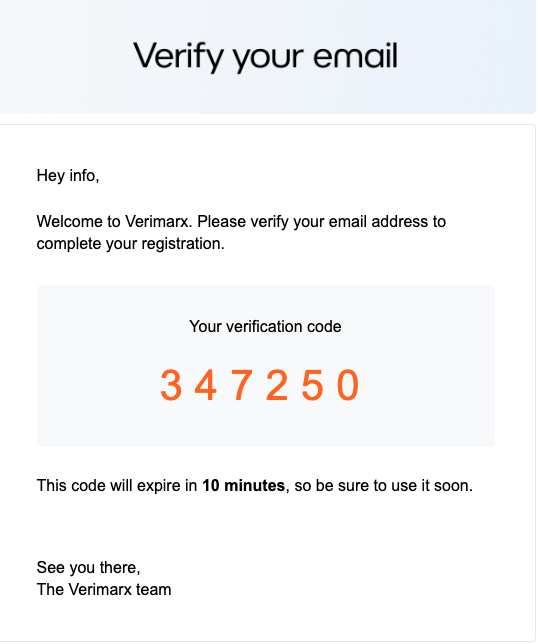
3. A confirmation e-mail with a one-time verification code will be sent to your provided e-mail address. Use this code to complete your account setup.
4. Once you are logged into the VeriMarx system, you will see the submission interface. This is where you will enter the name of the signer, and will upload the autograph / signature to be analyzed.
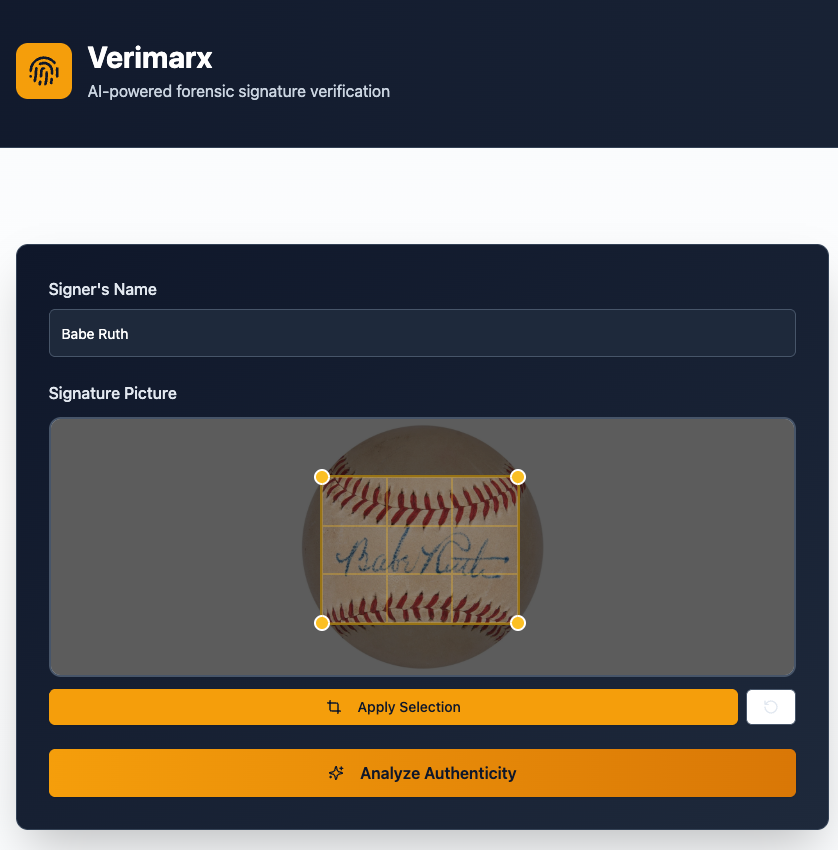
5. Enter the Name : ex. Babe Ruth
6. Upload photo, or take a picture with your mobile phone. Higher quality photos and signatures produce more accurate results.
7. Choose “Select Area” to select the actual signature. Drag the end-point on the selection box until the square fully captures the signature. Be sure to include the entire autograph.
8. Once you have selected the entire signature to be processed, click on the “Apply Selection” button. You can adjust if needed.
9. Once the selection is finalized, you are ready to start the analysis. Click or touch the “Analyze Authenticity” button.
10. The analysis process usually takes 1-3 minutes. Your final report will appear below the analysis window.
ADDITIONAL INFORMATION
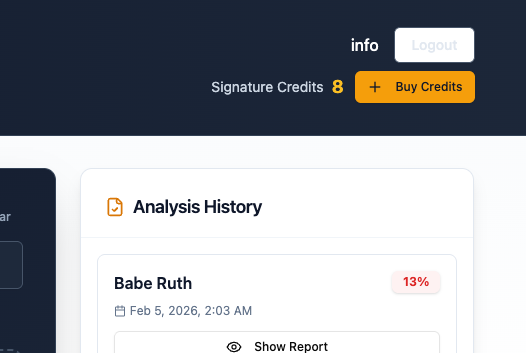
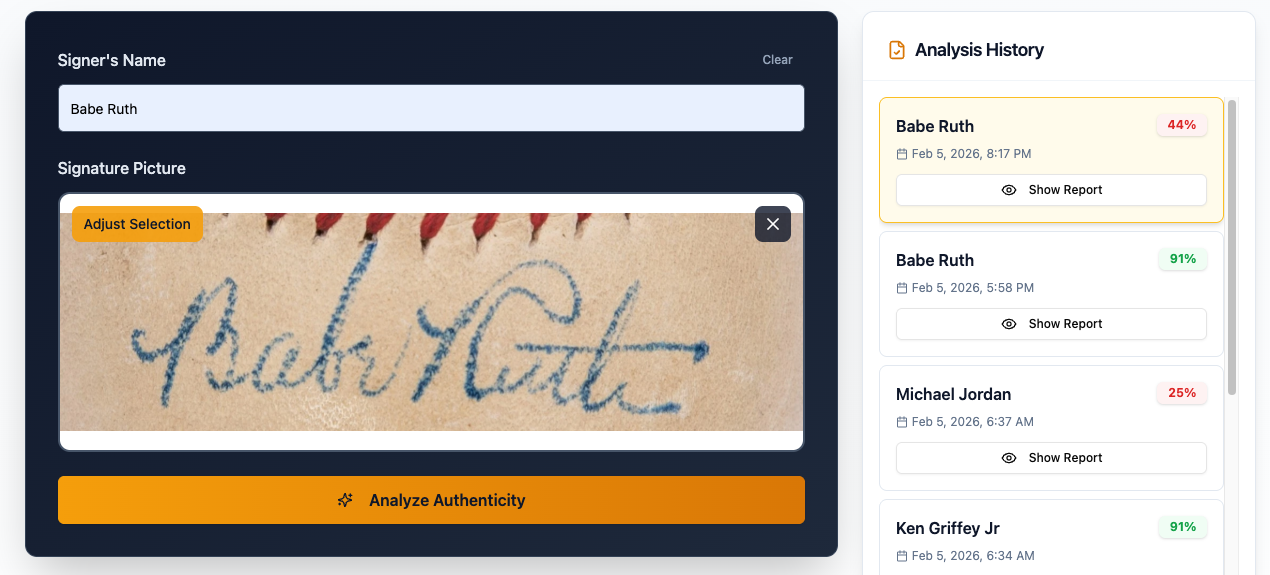
Analysis History: Once you have subscribed, and have an active account, all of your previous submissions will be available in the pane next to the submission window.
Signature Credits: Credits are purchased in single or multiple units. Remaining credits (submissions) will show in the upper-right navigation bar. Additional credits can be purchased using the “+ Buy Credits” button